
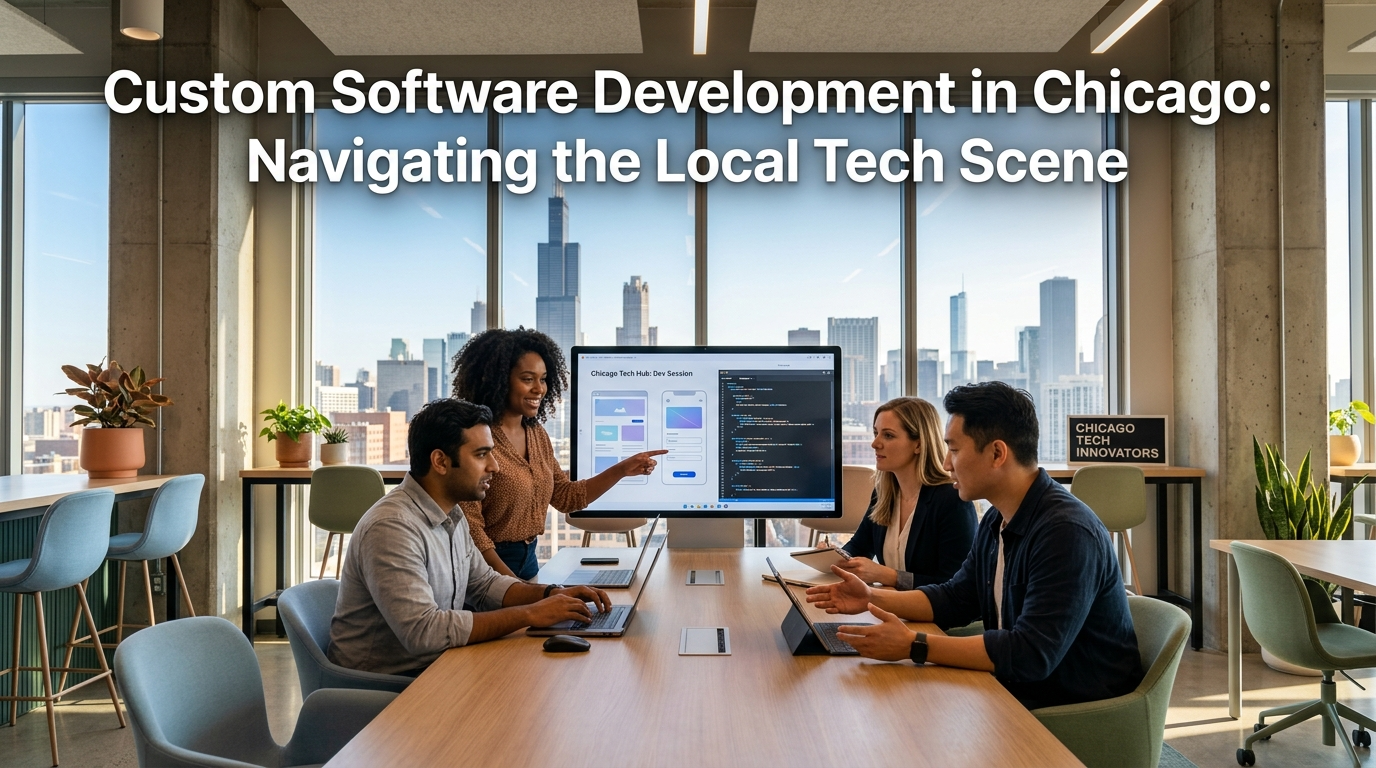
Introduction to Custom Software Development in Chicago
Chicago, a city renowned for its rich history and vibrant economy, stands as a significant player in the tech industry. As businesses seek to leverage technology for a competitive edge, custom software development emerges as a critical enabler, particularly with the advent of Artificial Intelligence (AI) solutions. This article explores the practical implementation of AI-driven custom software development within Chicago's dynamic tech landscape, the business value it presents, potential risks, workflows involved, key performance indicators (KPIs), and real-world examples.
The Importance of AI in Custom Software Development
AI technology is revolutionizing the way businesses operate, and its integration into custom software development is no exception. AI enables software to learn from data, improve over time, and make intelligent decisions, providing businesses with a tool that can adapt to changing needs and market conditions. In Chicago, companies are increasingly adopting AI-driven solutions to enhance efficiency, reduce costs, and gain strategic insights. The use cases for AI in custom software are vast, from predictive analytics and automation to customer service enhancements and beyond.
Practical Implementation of AI Solutions
Implementing AI in custom software development is a structured process that begins with identifying business needs and objectives. Chicago-based firms often start with a comprehensive needs assessment to determine where AI can add the most value. This involves consulting with stakeholders and analyzing business processes to pinpoint inefficiencies that AI can address.
Once the needs are established, the next step is to design and develop software tailored to meet those needs. This involves creating algorithms and models that can process data, recognize patterns, and deliver actionable insights. In Chicago, tech companies leverage local talent and partnerships with universities and research institutions to harness the latest AI advancements.
Following the development phase, thorough testing ensures that the software performs optimally and securely. This phase often includes simulations and pilot programs to refine AI models and ensure they align with business objectives. Deployment follows, with ongoing support and maintenance to handle any emerging issues and adapt to technological advancements.
The Business Value of AI-Driven Custom Software
AI integration in custom software development offers significant business value. In Chicago, companies across various industries are witnessing transformative impacts. AI solutions lead to improved decision-making capabilities through real-time data analysis and forecasting, allowing businesses to stay ahead of market trends.
Moreover, AI-driven automation streamlines operations by reducing manual tasks and increasing productivity. This efficiency not only reduces operational costs but also frees up human resources for more strategic roles. Additionally, AI enhances customer engagement through personalized experiences, ultimately boosting customer satisfaction and loyalty.
Risks and Challenges
Despite its benefits, AI-driven custom software development isn't without risks. The primary challenges include data privacy concerns, the potential for bias in AI models, and the need for substantial initial investment. Chicago businesses must navigate these risks by implementing robust data governance frameworks, ensuring transparency in AI decision-making processes, and demonstrating ROI to justify investment.
Effective Workflows and KPIs
Successful AI integration requires structured workflows and clear KPIs. Chicago firms typically adopt agile methodologies, promoting a collaborative and iterative approach to development. Key stages include sprint planning, development, testing, and review, each with defined KPIs such as speed of deployment, error rates, and user adoption metrics.
Measuring success involves tracking AI model performance, evaluating business impact, and continuously gathering feedback for improvements. KPIs like process efficiency, cost savings, customer satisfaction scores, and revenue growth are essential to assess the effectiveness of AI-driven custom software solutions.
Real-World Examples in Chicago
Several Chicago-based companies serve as exemplars of successful AI-driven custom software implementations. For instance, a leading logistics firm in Chicago leveraged AI to optimize its supply chain operations, resulting in a 20% reduction in delivery times and a significant decrease in logistical costs.
Another example is a healthcare provider that implemented AI solutions to enhance patient care management. By analyzing patient data, the provider achieved better resource allocation and improved patient outcomes, demonstrating the tangible benefits of AI integration in custom software.
Conclusion
Custom software development in Chicago, enriched by AI solutions, is reshaping the city's tech landscape. Through thoughtful implementation, businesses can unlock substantial value by enhancing operational efficiency, improving decision-making, and delivering superior customer experiences. However, navigating the challenges associated with AI is crucial for sustainable success. As Chicago continues to grow as a tech hub, the demand for innovative AI-driven custom software solutions is set to rise, offering promising opportunities for businesses to thrive in a competitive market.
The Role of Collaboration in AI Software Development
Collaboration is a cornerstone of successful AI-driven custom software development. In Chicago, the tech community thrives on collaboration between businesses, academic institutions, and startups. These partnerships facilitate the exchange of knowledge and expertise, ensuring that AI solutions are not only innovative but also practical and applicable to real-world challenges.
Universities in Chicago, such as the University of Chicago and Northwestern University, play a pivotal role by conducting cutting-edge research in AI and machine learning. Companies often collaborate with these institutions to tap into their research capabilities and recruit top talent. Startups, on the other hand, bring agility and fresh perspectives, often leading to disruptive innovations.
Additionally, tech meetups and networking events in Chicago provide platforms for knowledge sharing and foster a culture of continuous learning and improvement. This collaborative ecosystem is instrumental in driving the city's success in custom software development.
Steps to Mitigate Risks in AI Development
While the benefits of AI-driven custom software are substantial, addressing the associated risks is crucial. Chicago businesses can adopt several strategies to mitigate these risks effectively:
- Data Security and Privacy: Implement comprehensive data protection measures, including encryption and access controls, to safeguard sensitive information. Regular audits and compliance with regulations such as GDPR and CCPA are essential.
- Bias Mitigation: Ensure that AI models are trained on diverse datasets to minimize bias. Implement fairness checks and involve diverse teams in the development process to enhance model objectivity.
- Continuous Monitoring: Set up mechanisms for continuous monitoring and evaluation of AI models to detect and address any performance issues or biases as they arise.
- Transparent Communication: Maintain transparency in AI processes and decisions, providing stakeholders with clear explanations of how AI models function and their impact on business operations.
Emerging Trends in AI-Driven Custom Software
As technology evolves, new trends are shaping the future of AI-driven custom software development in Chicago:
- Explainable AI (XAI): With growing scrutiny on AI decisions, XAI is gaining traction. It aims to make AI systems more understandable to humans, allowing businesses to gain trust and compliance from stakeholders.
- AI and IoT Integration: The convergence of AI and the Internet of Things (IoT) is unlocking new possibilities. Chicago businesses are exploring this integration to create interconnected systems that enhance automation and data insights.
- Edge AI: Processing data closer to its source, known as edge AI, is becoming increasingly popular. It offers reduced latency and increased privacy, making it ideal for applications in healthcare and manufacturing.
Future Outlook: Expanding the AI Frontier
Looking ahead, the potential for AI-driven custom software development in Chicago remains vast. As AI technology continues to advance, businesses must stay informed about new developments to remain competitive. Investing in AI education and training for the workforce will be crucial to fully harness the capabilities of AI solutions.
Moreover, fostering an environment that encourages innovation and experimentation will be key to discovering novel applications for AI. As AI becomes more accessible and integrated into everyday business operations, it will undoubtedly continue to reshape industries and create new opportunities for growth and efficiency in Chicago's tech ecosystem.
Ultimately, the success of AI-driven custom software development in Chicago relies on a balanced approach that embraces both the transformative potential of AI and the importance of ethical, responsible implementation. By maintaining this balance, Chicago can continue to lead the way in technological innovation and provide a thriving environment for businesses to prosper.