
Understanding Social Distancing and Its Importance
Social distancing, also known as physical distancing, is a public health practice implemented to prevent the spread of contagious diseases. It involves maintaining a safe distance between individuals to reduce the transmission of pathogens. During the COVID-19 pandemic, social distancing emerged as a critical measure to slow the infection rate and protect vulnerable populations.
Despite its evident importance, social distancing presents challenges, especially in crowded environments such as workplaces, public transport, and retail spaces. This is where AI solutions have become invaluable, offering innovative ways to monitor and enforce social distancing guidelines.
The Role of AI in Social Distancing
AI technologies provide powerful tools to support social distancing measures. By leveraging machine learning algorithms, computer vision, and real-time data analysis, AI can monitor people’s movements and interactions in various settings. These solutions not only help in ensuring compliance but also in optimizing space utilization and enhancing operational efficiency.
Practical Implementation of AI Solutions
The implementation of AI solutions for social distancing follows a structured approach. Initially, businesses must assess their specific requirements and challenges. For instance, a retail store would need different solutions compared to a manufacturing plant. The next step involves selecting the appropriate AI technologies, such as CCTV systems with embedded AI capabilities or wearable devices that alert users when they are too close to others.
Once the technology is chosen, integration with existing systems and infrastructure is crucial. This may involve upgrading hardware, configuring software, and training staff to interact with the new systems. Continuous monitoring and data analysis allow for real-time adjustments and improvements, ensuring the effectiveness of the social distancing measures.
Business Value and Measurable Outcomes
Implementing AI solutions for social distancing can offer substantial business value. It enhances safety, which is paramount for employee morale and customer confidence. For example, a retail chain that uses AI to manage store occupancy can create a safer shopping environment, thus attracting more customers.
The measurable outcomes of these implementations can be tracked using key performance indicators (KPIs) such as the reduction in COVID-19 case rates among employees, customer footfall, and compliance rate to safety protocols. Businesses can also measure the return on investment (ROI) by analyzing the cost savings from reduced absenteeism and increased productivity.
Risks and Mitigation Strategies
While AI solutions offer significant benefits, there are inherent risks involved. Privacy concerns are paramount, as AI systems often rely on cameras and sensors that capture personal data. To mitigate these risks, businesses must implement robust data privacy measures, including anonymization techniques and secure data storage.
Additionally, there is a risk of over-reliance on technology. It is crucial to combine AI solutions with other health measures and ensure that human oversight is maintained. Regular audits and system updates can help address potential vulnerabilities and ensure the reliability of AI implementations.
Workflows for Effective Social Distancing
Successful AI implementation requires clear workflows. Initial steps include site assessments and technology selection, followed by system installation and staff training. Daily operations should include continuous monitoring and reporting to detect any non-compliance or system inefficiencies.
Feedback loops are essential to refine AI algorithms and improve accuracy. By collecting and analyzing data on interactions, businesses can identify patterns and make informed decisions to enhance their social distancing strategies.
Examples of AI-Driven Social Distancing Solutions
Several industries have successfully implemented AI solutions for social distancing. For example, manufacturing facilities use AI-powered cameras to ensure workers maintain safe distances on the production floor. In the healthcare sector, hospitals employ AI to monitor visitor movements and manage waiting areas efficiently.
The retail industry has also adopted AI, with smart shelves that monitor customer density and adjust displays to optimize space usage. These examples illustrate how AI not only supports social distancing but also contributes to operational improvements and customer satisfaction.
Key Performance Indicators for Success
Evaluating the success of AI solutions for social distancing involves tracking several KPIs. These include:
- Reduction in Incident Rates: A decrease in the number of close-contact incidents reported.
- Compliance Rate: The percentage of time social distancing guidelines are adhered to.
- Customer and Employee Satisfaction: Surveys measuring the perceived safety and satisfaction levels of stakeholders.
- Operational Efficiency: Improvements in workflow and space utilization metrics.
Conclusion: The Future of Social Distancing with AI
AI solutions have revolutionized the way businesses approach social distancing. By providing accurate, real-time monitoring and analysis, AI not only helps ensure compliance but also drives significant business value. As technology advances, the integration of AI in public health strategies is likely to expand, offering even more sophisticated tools for managing pandemics and other health crises.
Ultimately, the successful implementation of AI for social distancing hinges on a balanced approach that combines technology with human oversight and robust privacy measures. By doing so, businesses can protect their employees and customers while maintaining operational efficiency and fostering trust.
Adapting AI Solutions to Different Environments
The efficacy of AI solutions for social distancing largely depends on their adaptation to specific environments. Each setting, whether it’s retail, healthcare, or office spaces, presents unique challenges and opportunities. Therefore, a tailored approach is crucial for maximizing the benefits of AI technologies.
Retail Sector Adaptation
In the retail sector, AI can be integrated with existing point-of-sale systems and customer management tools to regulate store capacity. AI-driven heat maps can track customer movements and identify high-density areas that require intervention. Retailers can use this data to optimize store layouts, enhance customer flow, and implement staggered entry systems during peak hours.
Healthcare Sector Innovations
In healthcare settings, AI can play a vital role in managing patient interactions and ensuring safety. Automated systems can monitor patient waiting areas and send alerts to staff when overcrowding occurs, allowing for quick interventions. By integrating AI with electronic health records, healthcare providers can also streamline check-in processes, reducing the need for physical interactions.
Office Environment Strategies
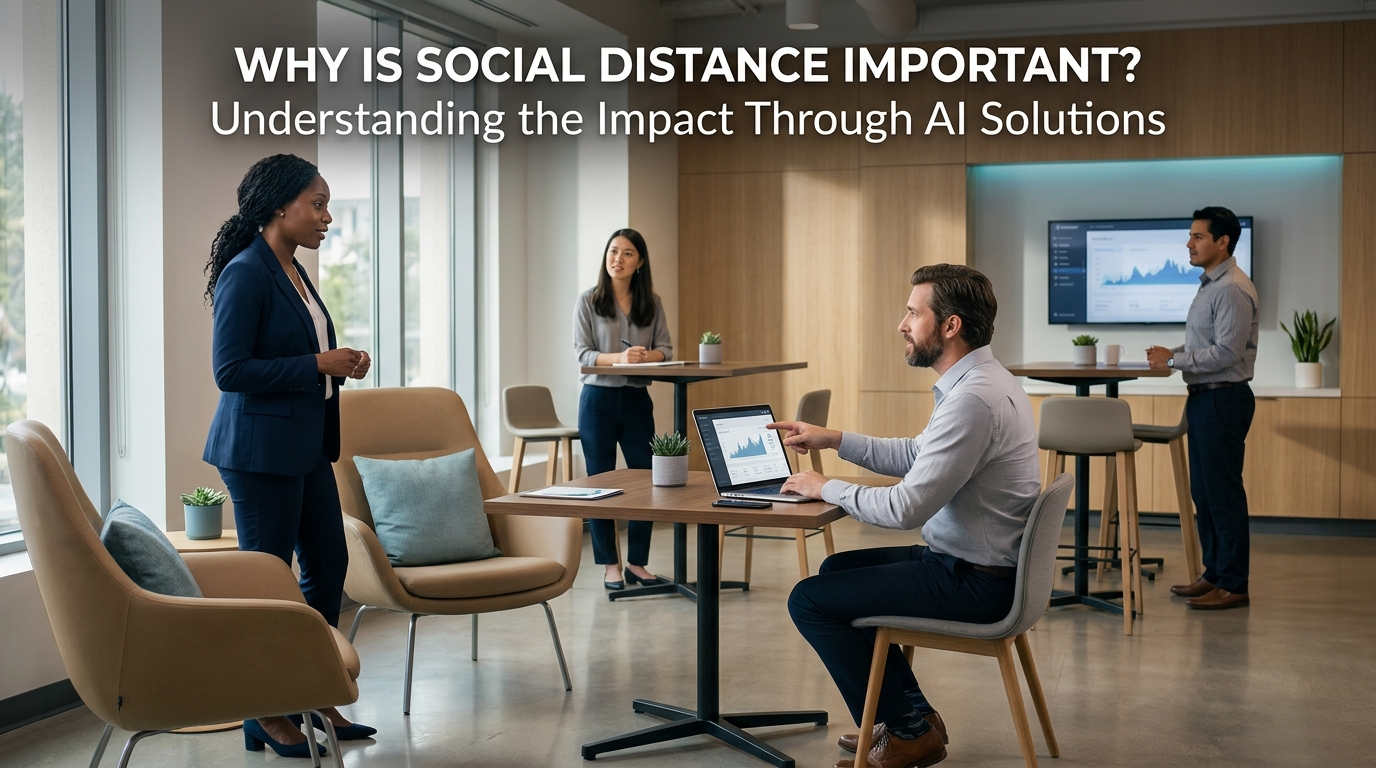
For office environments, AI can facilitate hybrid work models by monitoring space utilization and employee movements. AI can analyze occupancy data to determine the optimal number of employees in the office at any given time, supporting flexible work arrangements and reducing the risk of contagion.
Enhancing AI Solutions with Emerging Technologies
AI's capabilities can be further enhanced when combined with other emerging technologies. For example, integrating Internet of Things (IoT) devices can provide additional data points for AI, improving accuracy and responsiveness.
IoT Integration
IoT devices, such as smart sensors and wearable technology, can feed real-time data into AI systems, allowing for more precise monitoring of social distancing compliance. These devices can track environmental changes and alert users when protocols are breached, thus providing instant feedback and promoting adherence to guidelines.
Blockchain for Data Security
Implementing blockchain technology offers a secure way to manage the data collected by AI systems. By decentralizing data storage, blockchain ensures data integrity and provides an immutable record of interactions, which is vital for auditing purposes and compliance with privacy regulations.
Case Studies: Successful AI Implementations
Several organizations have successfully leveraged AI for social distancing, demonstrating the potential of these technologies to transform public health practices.
Case Study 1: Retail Chain Transformation
A major retail chain implemented AI-powered analytics to monitor in-store customer interactions. By using computer vision, the chain reduced close-contact incidents by over 30%, enhancing the safety and confidence of both customers and employees.
Case Study 2: Hospital Innovation
A large hospital network integrated AI with their patient management systems to manage overcrowding in waiting areas. The result was a marked improvement in patient throughput and a reduction in wait times, highlighting AI's role in enhancing healthcare delivery.
Case Study 3: Corporate Office Efficiency
A global corporation utilized AI to manage their return-to-office phase during the pandemic. By analyzing occupancy data, they maintained optimal employee density, ensuring safety while supporting productivity.
Future Outlook: AI's Evolving Role
As AI technology continues to evolve, its role in managing public health will likely expand. Future developments might include more sophisticated algorithms capable of predicting outbreaks based on behavioral patterns and environmental factors.
The integration of AI into public health strategies will pave the way for more resilient systems, capable of responding swiftly to emerging health threats. By continuing to refine AI technologies and their applications, businesses and public health authorities can better protect populations and maintain operational continuity in the face of future pandemics.